Kalinia’s male-heir inheritance regime
The Ballad of the Last DragonKalinia’s male-heir inheritance regime is an exclusionary local system under which property passes to a suitable male heir or is absorbed by the town, leaving widows, daughters, and other relatives vulnerable to eviction after a family death. The regime gives legal form to a wider social order in which authority, land, and public credibility are distributed along gendered and hierarchical lines; its eventual challenge becomes one of the book’s clearest examples of turning private grief into institutional change.
Definition and Legal Operation
Kalinia’s law remains deliberately out of step with Queen Dhara’s inclusive land and title policies. Although those royal policies support broader ownership and next-of-kin protections, Kalinia’s local magistrate still enforces an archaic rule: when no suitable male heir exists, the town absorbs the inheritance. The system therefore treats a household’s land and buildings less as the foundation of a surviving family’s life than as an asset awaiting transfer under male-centered criteria.
The law also operates through exclusion from ordinary legal remedies. Rhosyn has repeatedly petitioned Magistrate William M. Ridion to bypass the inheritance rules, establish a binding stewardship arrangement, or buy out the deed, but he refuses each attempt. The magistrate is not required to adopt the newer by-laws under Queen Dhara, and Kalinia has not accepted inheritance by testament or a broader definition of next of kin. Local sovereignty thus becomes a shield for preserving dispossession.
Human Cost and Family Responsibility
The regime’s consequences become concrete after Damir’s death. Damir built the house where Rhosyn lives with their daughters, and the property carries the physical traces of his labor: familiar floorboards, a partly driven nail, and the accumulated presence of generations. Rhosyn does not seek marriage to Jaromir for affection or status. She wants her daughters to retain their home and to remain surrounded by the place where their father’s life is still materially present.
Jaromir’s obligation is equally shaped by the law. Because Damir’s land, farm, and house pass to Jaromir rather than to Rhosyn, Jaromir offers Rhosyn his hand in title only, promising that she will be protected if he dies. He regards her as family and treats preserving her home as a duty arising from Damir’s death. Yet the arrangement creates a second injustice: Rhosyn and Jaromir are expected to enter a winter marriage neither genuinely desires. They are permitted to live as unattached people before the ceremony and to seek pleasure elsewhere, but the eventual rites are understood as binding. Rhosyn has friendship and respect for Jaromir, not romantic love, and her precarious housing position makes a supposedly voluntary marriage difficult to separate from legal coercion.
The inheritance regime also exposes the limits of revenge as a response to structural harm. After Sylvaine Abelan is assaulted, she gains the power to kill one of her attackers, with the sword poised at his pulse and the immediate possibility of reversing the fear imposed on her. She stops because she does not want his death to become a permanent burden. Her refusal does not erase violence, but it distinguishes personal retaliation from the later choice to confront the institution that produces vulnerability. In Kalinia, the more lasting answer to dispossession is not another death but a change in the rule itself.
Reform at the Magistrate’s Office
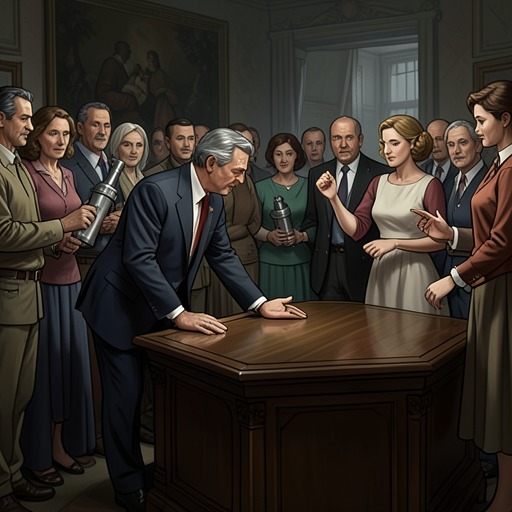
Rhosyn has already exhausted the polite legal route when Sylvaine Abelan, Rhosyn, and Jaromir confront Ridion. Sylvaine chooses coercion because ordinary petitioning has failed. Jaromir’s presence ensures that Ridion will listen, while Sylvaine uses the cultural power of performance and public storytelling as leverage. She points to the coming election for magistrate and makes clear that a scandalous song could damage Ridion’s prospects.
The confrontation turns the law’s own public authority against it. Ridion initially assumes that Jaromir has come either to accept Damir’s inheritance or to sign it over to the town. Jaromir rejects both options. Rhosyn then states the actual demand: Ridion must abandon the antiquated inheritance law, amend it so that family tragedy cannot throw people from their homes, serve the people instead of taking from them at their most vulnerable, and enact Queen Dhara’s inclusive land and title policies in Kalinia.
Sylvaine has prepared the legal instrument herself. When Ridion protests that drafting documents, finding a scribe, and securing a notary will take time, she produces the legislation written at Rhosyn’s table and offers to witness the signature and official seal. Jaromir physically presses Ridion toward the desk as a warning, while Sylvaine insists on triplicate copies so that the reform cannot conveniently disappear. Ridion finally signs and stamps the documents, accepting the change under pressure rather than through a spontaneous conversion to justice.
Wider Political Context
The local inheritance regime belongs to a broader history in which law, property, ethnicity, and violence reinforce one another. During The Unification, dwarves who fought alongside humans were rewarded with land and minor titles in Targgein, while human and dwarven histories portrayed both groups as heroic opponents of the ancient elves. The resulting political memory helped normalize the idea that authority and land belonged to favored communities and their institutions.
Elven persecution demonstrates the same logic in a more extreme form. Elves lose the right to hold titles, including land; those who refuse to surrender property and move into cities subject to searches and curfews are branded fugitives; and humans receive licenses to hunt them for sport after paying a taxation fee. In taverns, an elven performer can be ordered to fetch drinks and addressed as a “knife-ear,” while the memory of raids and destroyed elven texts leaves surviving history dependent on oral transmission. These practices show how a legal classification can convert belonging into conditional permission and property into a mechanism of control.
The remnants of that political violence remain visible elsewhere in the quest. The party encounters corpse-eaters prowling a nest, embodiments of a landscape made terrifying by death, and discovers four barrels of black powder in the dragon’s underground mechanisms. Saltpeter had been outlawed after the dwarven alliance with humans during The Great Loss because explosive warfare was judged inhumane only after it had helped defeat the elves. Against this background, Kalinia’s inheritance rule appears not as an isolated technicality but as another surviving local structure through which old hierarchies continue to distribute safety and danger unevenly.
Significance and Aftermath
Kalinia’s male-heir inheritance regime converts mourning into a legal emergency. Damir’s death threatens Rhosyn’s home, her daughters’ continuity, and the material memory of a family, while forcing Jaromir toward a marriage framed as duty rather than desire. The crisis also clarifies the difference between a royal reforming ideal and a town’s entrenched administrative practice: inclusive policy can exist in principle while a local magistrate preserves exclusion in fact.
Its reform marks a shift from individual protection to collective entitlement. Rhosyn no longer depends solely on Jaromir’s promise to safeguard her, and Jaromir is no longer required to stand as the male conduit through which her household can survive. Sylvaine’s intervention makes the law answerable to the people it has endangered, using testimony, political embarrassment, prepared legal language, and the threat of public song to force institutional recognition. The regime’s defeat therefore carries both a practical and symbolic consequence: a home previously protected only by family sacrifice becomes something the law must recognize as belonging to those who live and build their lives within it.